TOPCLOCKS GUIDE

Alarm Clocks Matched to How You Wake

Compare sound, sunrise light, vibration, movement, and task alarms for your room and sleep routine.

Explore

Diagnose before you compare

What Must Your Next Alarm Do That Your Current One Cannot?

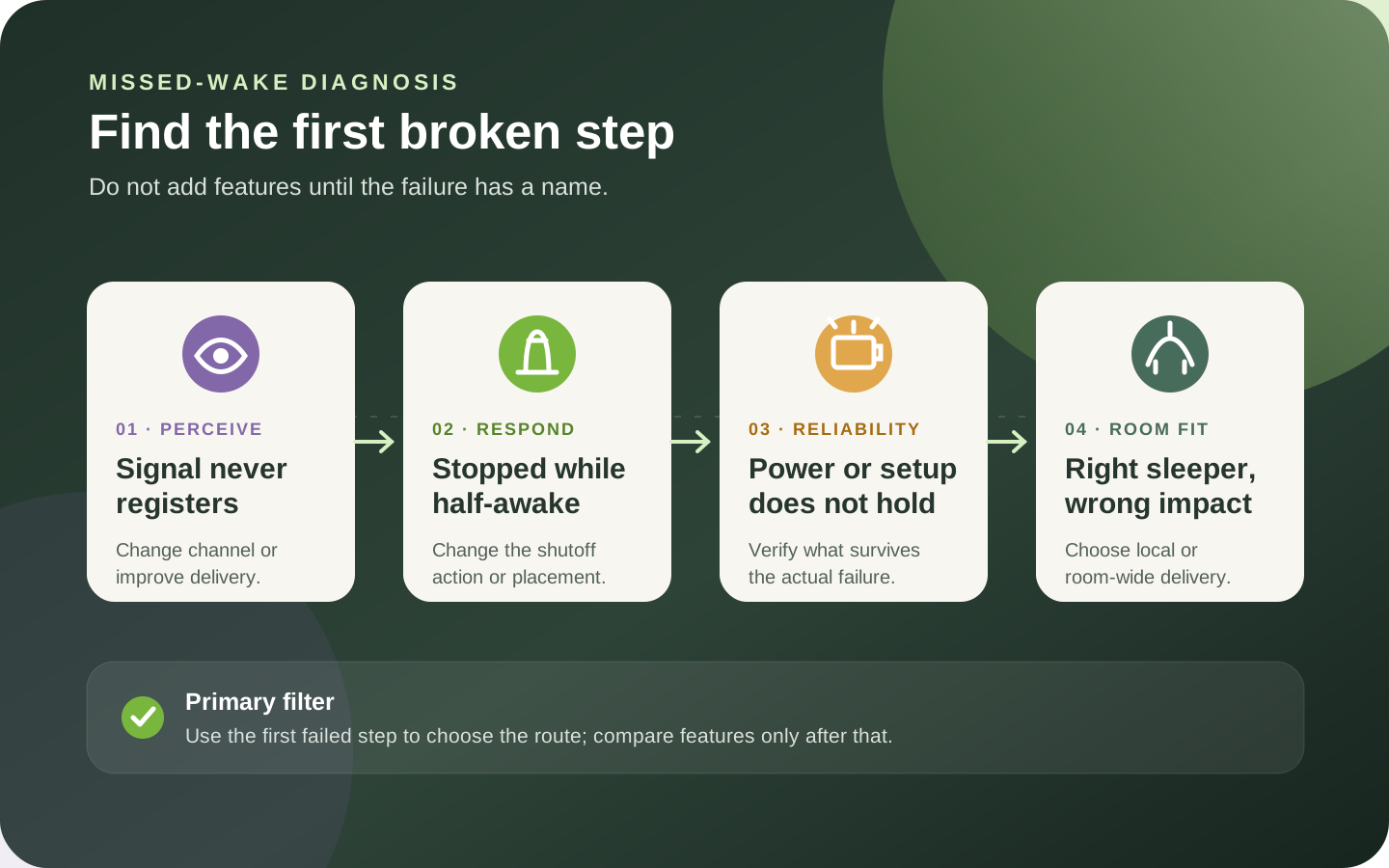
A missed alarm can look like one problem from the outside, yet the failure may happen at four different points. You might never perceive the alert. You might hear it and silence it without becoming fully awake. The device may lose power, a schedule, or a connection. Or the alarm may work for you while creating an unacceptable problem for someone else in the room.

Start with the failed morning, not with a feature wish list. That keeps the choice tied to a real job: make the wake-up signal noticeable, make the shutoff deliberate, keep the alarm armed overnight, and contain its effect when another sleeper needs quiet. Once the failure is named, the useful product categories become much easier to separate.

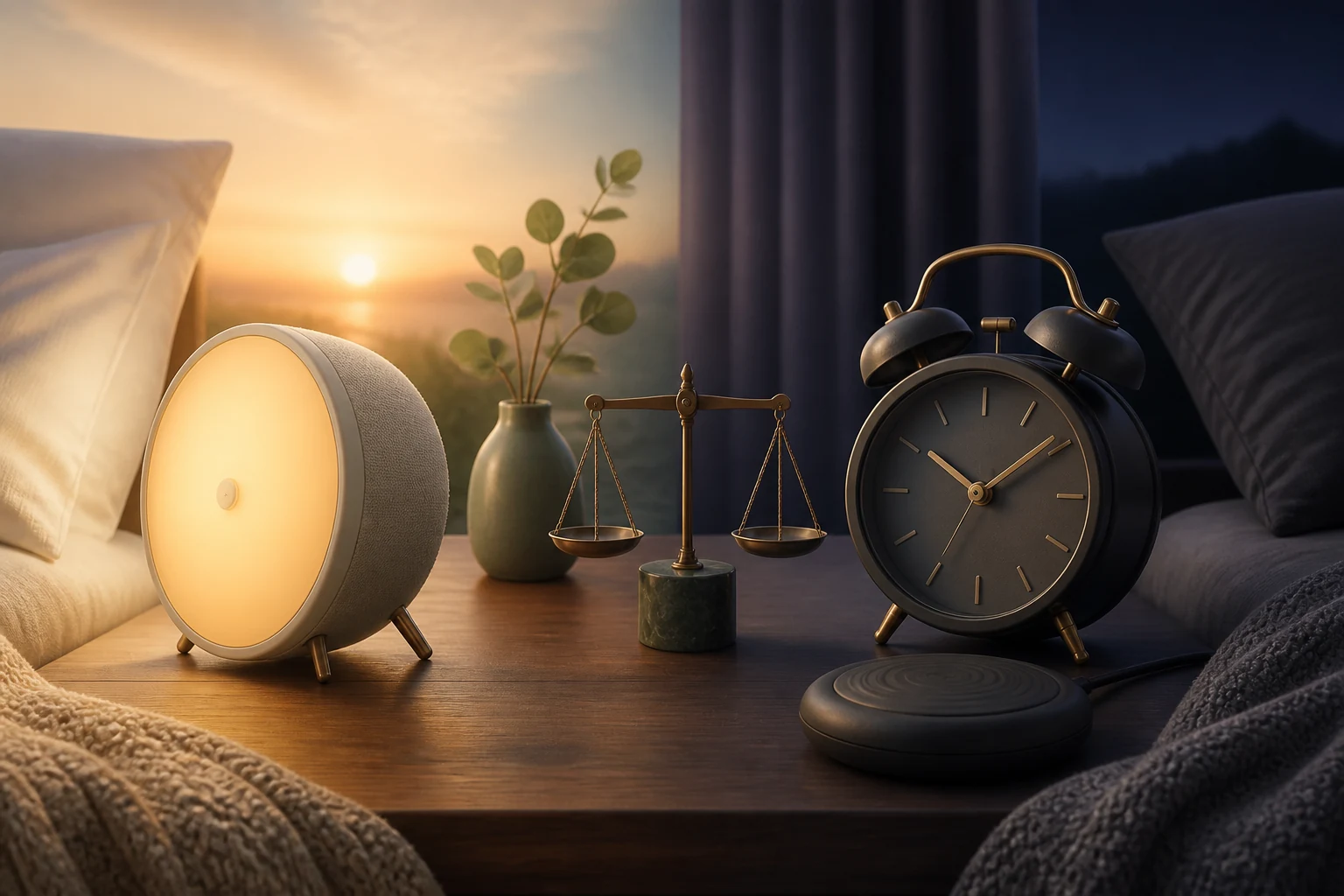
Decision map separating alarm failures into perception, half-awake response, overnight reliability, and room impact
Trace the failure to the first point that breaks. A louder version of the same signal only helps when perception is the actual problem.

Failure 01

You never notice the alert

Change the signal channel or its delivery before adding convenience features. Sound may need a different tone or better placement. Light has to reach the sleeper rather than brighten an empty side of the room. A bed shaker must transfer vibration through the actual mattress or bed frame. When one channel is unreliable, a second independent channel can provide useful redundancy.

Compare alarm-clock signal types
Failure 02

You silence it without getting up

More volume may wake the room without changing the half-awake habit. Look instead at the shutoff sequence: control placement, movement, a task, a remote shaker, or enough distance to require leaving bed. The aim is not to make dismissal annoying for its own sake. It is to create a deliberate action before the alarm can be stopped.

Repair a missed-alarm routine

Failure 03

The setup is not dependable overnight

Check what remains active after a power interruption, a phone restart, lost Wi-Fi, an expired subscription, or a schedule change. “Battery backup” does not always mean the same thing: on some models it keeps the alarm operating, while on others it only preserves time and settings. The manual and an unplugged test matter more than the label on the box.

Check backup-power behavior

Failure 04

The signal wakes the wrong person too

A room-wide signal and a local signal solve different problems. Loud sound and bright light can spread across the bedroom. Vibration can stay closer to one side of the bed, although placement still matters. Couples also need to check separate schedules, how quickly each alarm can be stopped, and whether both alarm times remain easy to verify in the dark.

Choose an alarm route for couples

Use the first failed step as the primary filter

If perception fails, compare sound, light, or vibration. If the response fails, compare movement and shutoff friction. If reliability fails, check power and setup dependence. If the room is the problem, compare local and room-wide signals. The Alarm Clock Finder turns those answers into a shorter route through the hub.

Choose the depth you need

Open the Right Alarm Clock Cluster

These six routes organize the hub by decision stage. Use a cluster when you need to explore a family of answers; use the Finder when you want the shortest path from a failed morning to a workable setup.

Wake Signal System

How Should the Alarm Reach You?

Start with the mechanism that can break through sleep. The extra features matter only after the signal, the room, and the sleeper line up.

Sound

Tone or bell.

Good start
Sleepers who hear alarms consistently.
Watch for
Carries across the room.
Pair with
Light or vibration

Light

Gradual brightness.

Good start
Dark bedrooms and less abrupt mornings.
Watch for
Must reach the sleeper.
Pair with
Sound

Vibration

Bed shaker or wearable.

Good start
Silent, local, or accessibility-first alerts.
Watch for
Placement and compatibility.
Pair with
Light

Movement

Makes you leave bed.

Good start
People who dismiss alarms in place.
Watch for
May disturb the room.
Pair with
Sound or vibration

Task

Adds a shutoff action.

Good start
Automatic snoozers.
Watch for
May depend on a phone or app.
Pair with
Separate backup alarm

Choose your wake-up signal

Explore Alarm Clock Types

Start with the signal most likely to reach you, then compare the controls and features that shape the rest of the night.

After the signal choice

What Changes When You Move from a Signal to a Clock Type?

A category name often describes only one layer of the product. “Digital” describes the display, “projection” describes where time appears, and “radio” describes an audio source. None of those labels guarantees a particular wake-up strength. Keep the wake signal fixed while you compare the form, controls, power arrangement, and bedside role.

Room-wide audible alarms

Loud alarm clocks are the direct route when an audible alert is too easy to miss. Compare adjustable volume, tone character, escalation, placement, and shutoff access rather than chasing the largest number in a specification. A clock radio may offer a more familiar sound source, but radio reception and station choice do not by themselves make the wake-up signal more reliable.

Local physical alerts

Vibrating alarm clocks deliver the alert through a bed shaker or another physical device. They are useful when sound is ineffective, unsuitable, or likely to disturb the whole room. Verify what the shaker connects to, where it can be placed, whether the cable reaches safely, and whether sound or flashing light can be enabled as a separate backup.

Gradual light before alarm time

Sunrise alarm clocks begin the wake sequence before the set time by increasing light. Their key constraint is line of sight: a lamp that faces away from the sleeper or competes with a bright room may not deliver the intended cue. When punctual waking is nonnegotiable, compare models that can pair light with sound instead of assuming light alone will work on the first morning.

Display and bedside platform choices

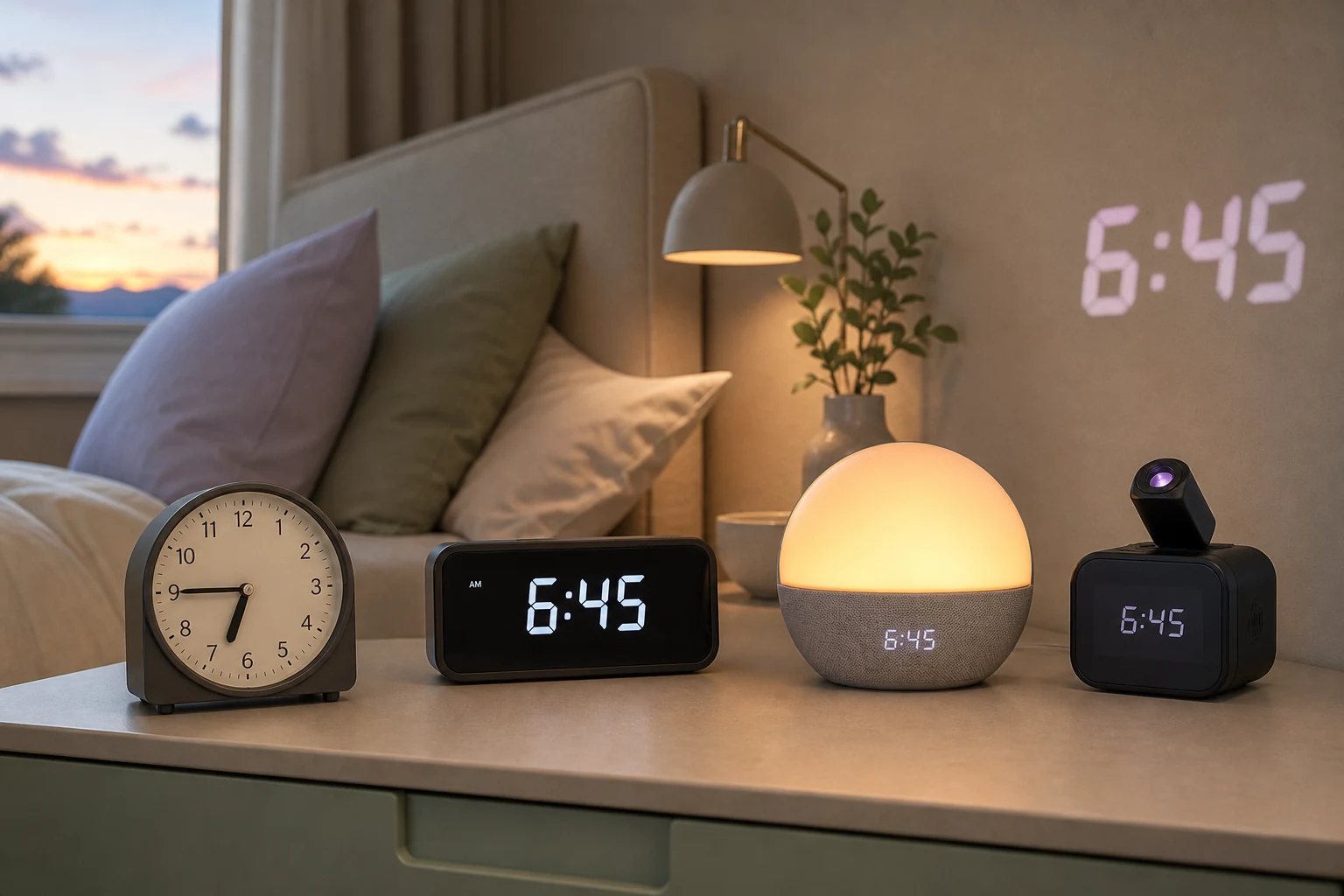
Digital, analog, projection, smart, and travel clocks answer different secondary questions. Decide how the time should be read, whether the display must disappear at night, how much setup is acceptable, and whether the clock needs to move. Then confirm that the alarm signal still matches the sleeper.

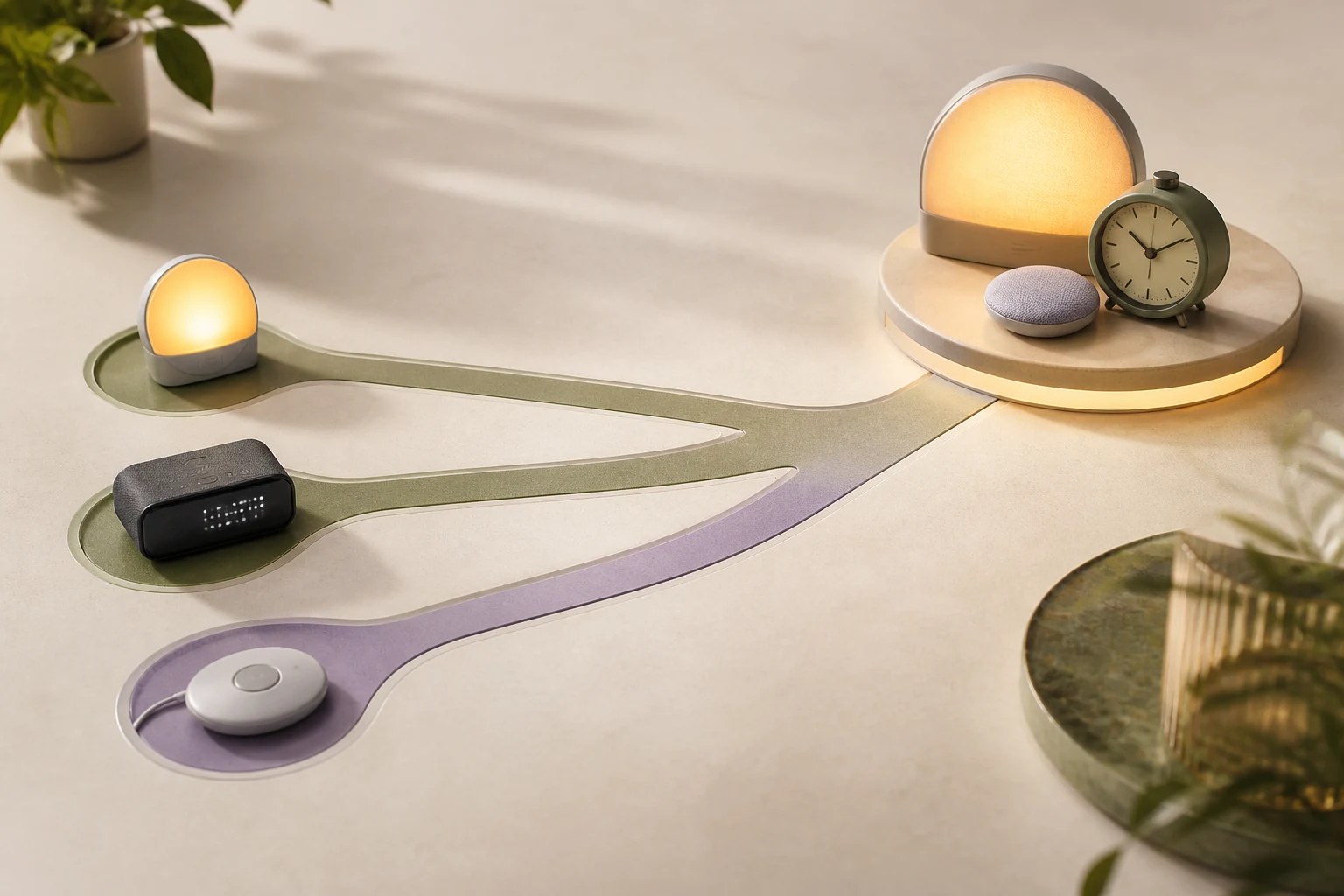
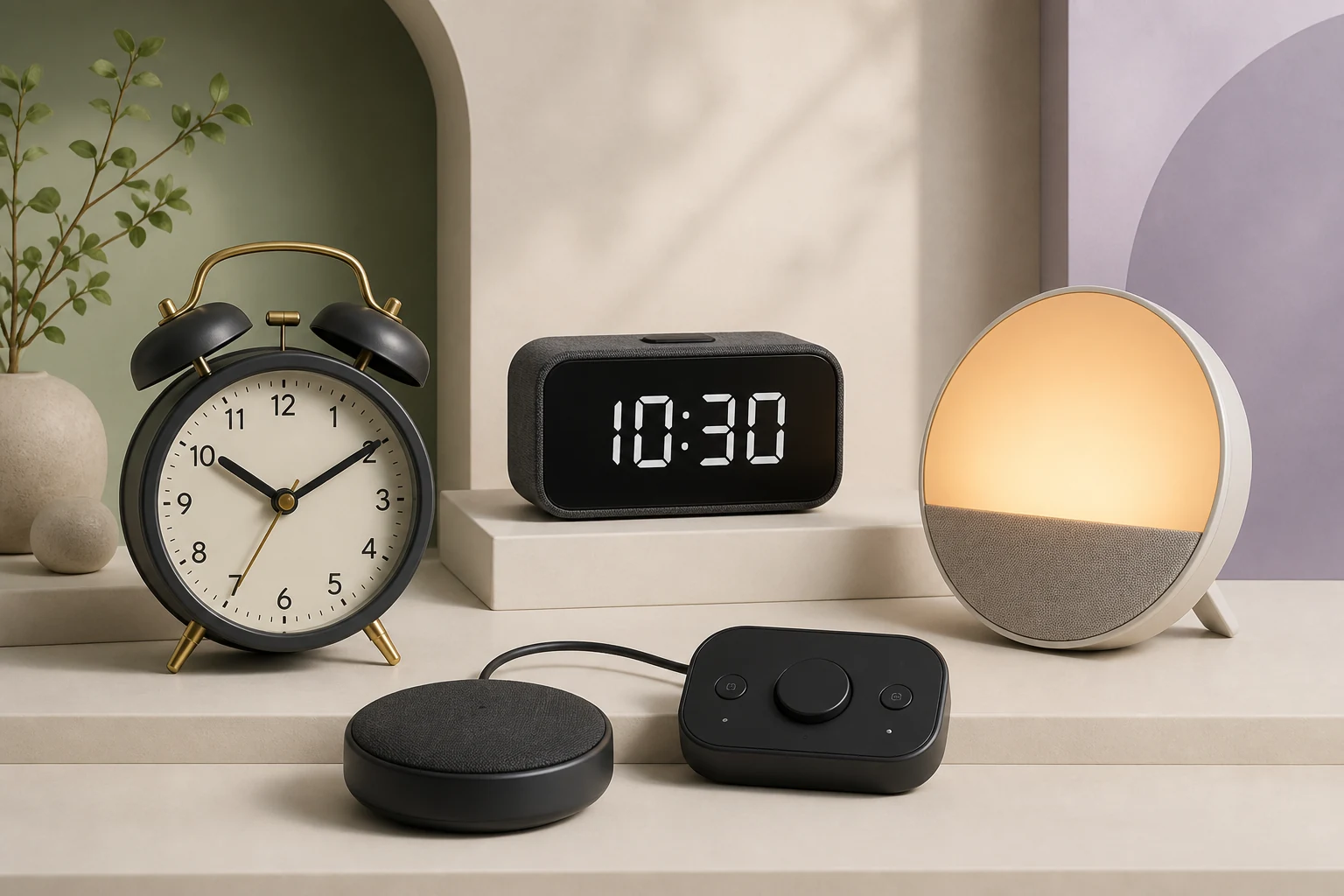
Generic analog, digital, sunrise-light, and projection clocks arranged for a type comparison
See every alarm clock type and keep the wake-up mechanism fixed while the format changes.

After the wake-up signal

Alarm Clock Features That Change the Choice

These details can rule a model in or out. They are not substitutes for a signal that actually reaches the sleeper.

Pass or reject

Use Features as Disqualifiers, Not as a Scoreboard

A useful feature resolves a known constraint. An irrelevant feature adds setup, cost, light, cables, or controls without making the morning safer. Before keeping a model on the shortlist, turn each desired feature into a question that can be answered from the manual or during a first-night test.

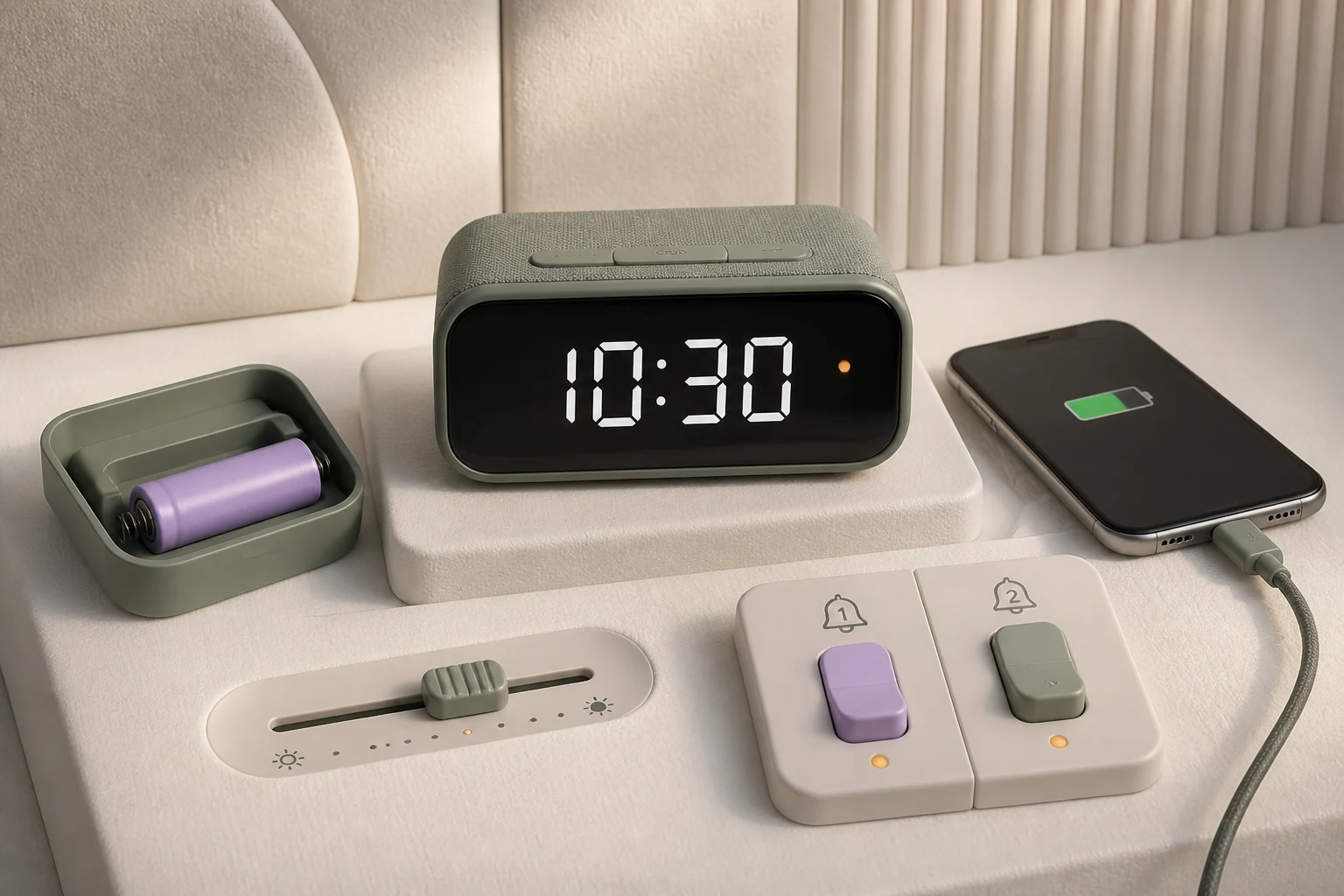
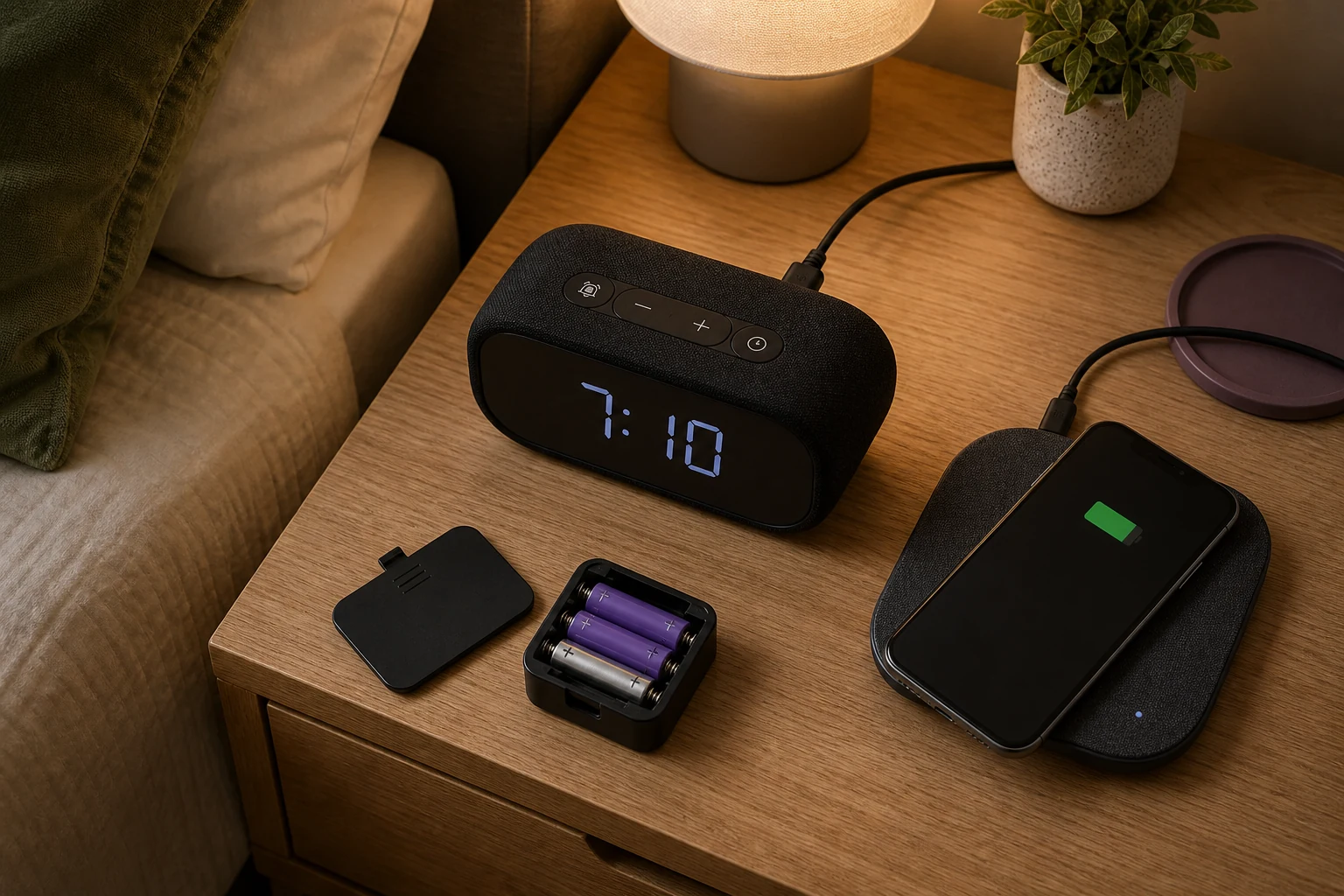
Alarm clock feature check with backup batteries, charging pad, visible controls, and dim display
Verify the complete bedside setup: power behavior, charging position, control access, and display light.
Battery backup
Does the battery sound the alarm during an outage, or does it only preserve the clock and schedule? If the main job stops when mains power disappears, decide whether a separate battery alarm is required.
Dual alarm
Can each time use its own days, signal, volume, and on/off state? Two stored times are not enough when two people or a weekday/weekend routine need genuinely independent behavior.
Dimmable display
Can the display turn fully off while the alarm remains armed? Check whether touching a control restores the display temporarily and whether the lowest setting is still distracting from the sleeping position.
Charging
Will the phone sit where charging does not cover the snooze or alarm controls? Confirm port type, cable placement, and whether wireless charging requires precise alignment that becomes awkward in the dark.
Smart control
Which essential functions remain available on the clock itself? An app can simplify schedules, but the alarm should not become impossible to verify or stop when the phone, account, network, or service is unavailable.
Radio, white noise, and bedtime audio
Are these part of the wake-up job or simply useful bedside extras? Evaluate the alarm signal separately. A better speaker or larger sound library does not prove that the alarm controls are clear at 2:00 a.m.

Compatibility comes before convenience

Keep a feature only if it passes three checks: it solves a named problem, it still works under the conditions you depend on, and it does not interfere with the alarm’s primary controls. Use the dedicated alarm clock features hub when a feature is the deciding constraint, then return to the type page to compare models that meet it.

Browse by maker

Explore Alarm Clock Brands

Pick the wake-up signal first. The brand cards then narrow the field within that type.

Philips SmartSleep

Sonic Alert

Loftie

Lumie

Sharp

iHome

DreamSky

JALL

Start with the problem

Who Are You Waking?

A clearer way to choose

Choose the Signal Before the Extras

A useful alarm clock reaches the sleeper without creating a new problem.

Volume is only one route. Light suits some dark mornings; vibration can keep an alert local. A combined alarm adds backup when one signal is easy to miss. Account for the sleeper, the room, and power behavior before radio, charging, white noise, or app control.

Match the signal to the sleeper

Sound is familiar, but not universal. Sunrise models brighten the room; bed shakers turn the alert into vibration. If one signal is easy to miss, compare alarms that combine two.

Protect the other side of the bed

Dual alarms suit separate schedules. Vibration or a local signal may disturb less of the room. Also check whether the alarm can be stopped quickly in the dark.

Check what happens when power fails

Battery backup may only preserve the time and settings. Check the manual before relying on it. Smart clocks can add app setup, accounts, subscriptions, or internet dependence.

How models will be judged

Wake Reliability, Not Feature Count

Specifications alone do not show how an alarm behaves at night or in the morning. Reviews will label the evidence behind each conclusion.

Signal coverage
Supported wake-up mechanisms
Night controls
Setup, snooze, and shutoff in the dark
Partner impact
Signal spread and shutoff speed
Power behavior
What runs and what is only saved
Accessibility
Contrast, buttons, tactile controls, and silent modes
Ownership friction
Apps, accounts, subscriptions, and batteries

No model ranking will appear until the evidence supports both a best use case and a failure case.

Before the first important morning

Run a First-Night Test While the Consequence Is Small

A specification can show that a feature exists. It cannot show whether you can find a control in a dark room, whether a shaker transfers through your bed, whether the light reaches your face, or whether another sleeper hears the alert first. Test the complete setup before relying on it for work, school, travel, medication timing, or another fixed commitment.

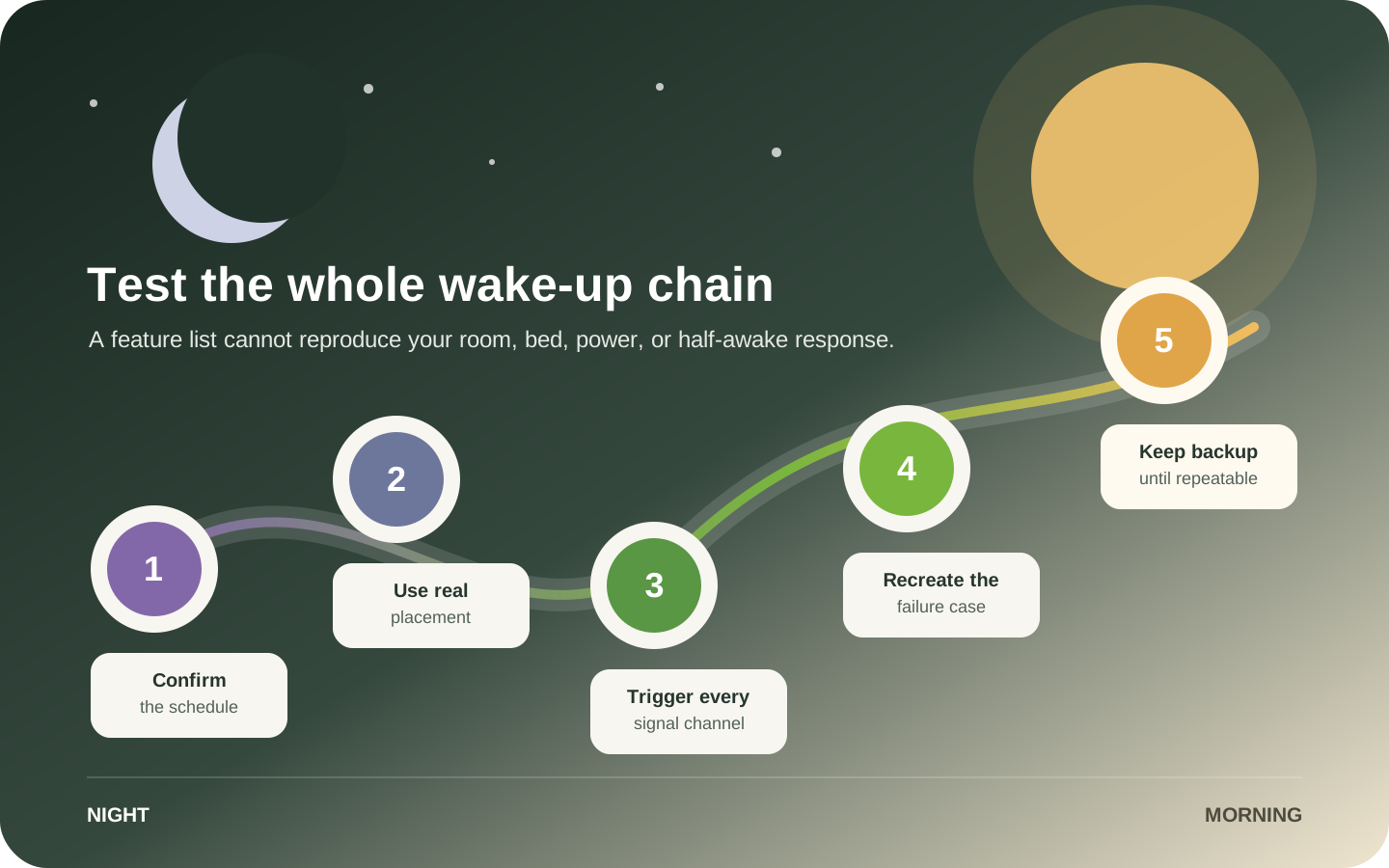
Five-step first-night alarm clock test covering setup, placement, signal, power, and morning verification
Test the chain, not one feature: schedule, placement, signal delivery, power behavior, and the morning result.
  1. Set it without using memory

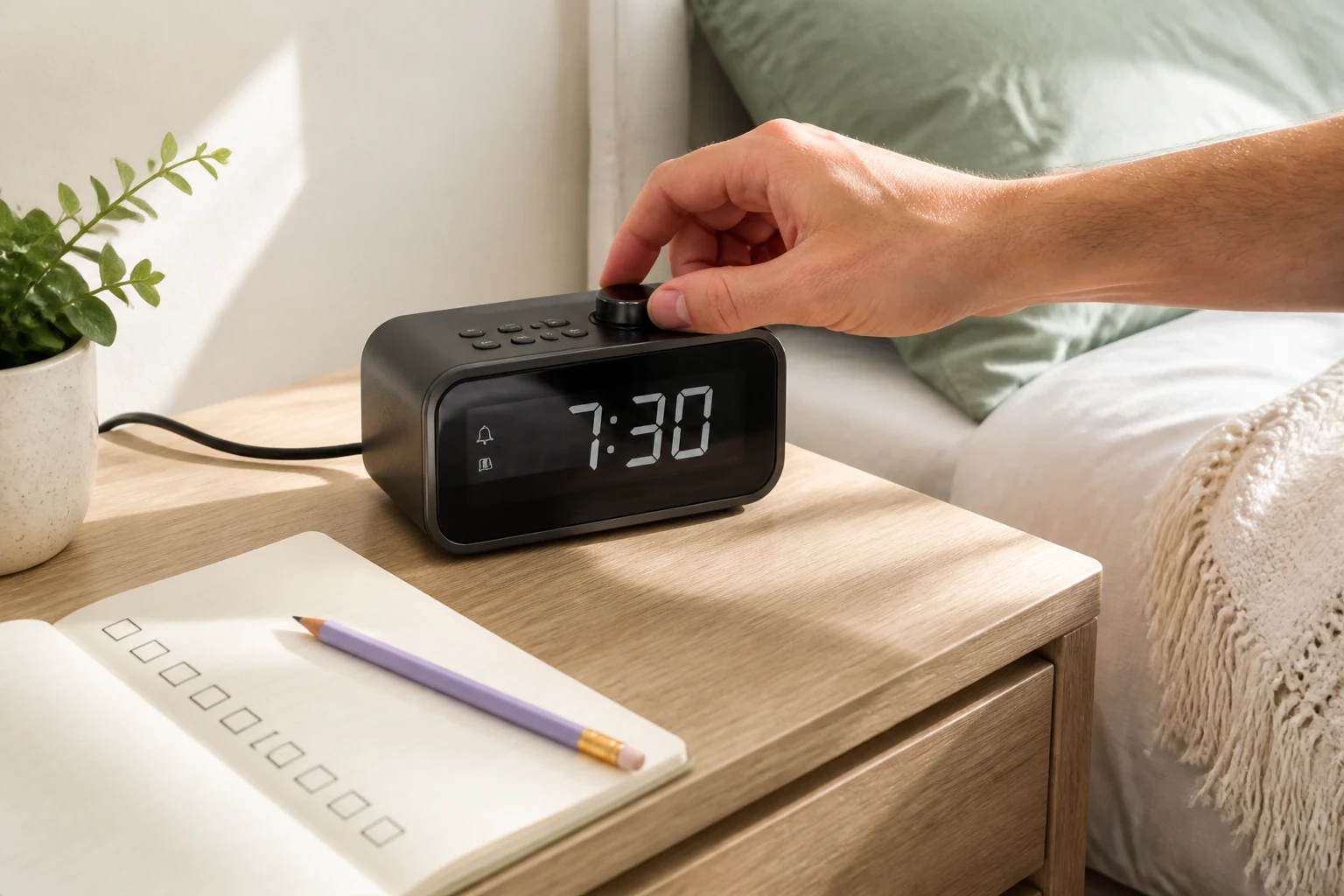
    Follow the current manual and confirm the displayed alarm time, AM/PM state where applicable, selected days, signal, volume, light level, and alarm-enabled indicator. If the clock depends on an app, verify the schedule on the device as well whenever the design allows it.

  2. Place every part where it will stay

    Use the real nightstand, outlet, mattress, pillow position, and charging cable. Point a wake-up light toward the sleeper. Route shaker and power cables so they are not pulled loose by normal movement. Keep essential controls reachable without covering them with a phone or book.

  3. Trigger a short daytime alarm

    Set an alarm a few minutes ahead and test each enabled channel. Walk to the normal sleeping position. Check the sound at that distance, the visible light from the pillow, the physical transfer of vibration, and the time needed to identify snooze and stop controls.

  4. Test the failure you care about

    If power loss is the concern, use the manufacturer’s instructions and verify what continues after unplugging. If the phone or Wi-Fi is the concern, confirm which clock functions remain local. If partner disturbance is the concern, test the local signal first and observe how far it spreads.

  5. Keep a fallback until the result is repeatable

    For the first important mornings, keep the previous alarm or a separate backup at a different location or on a different power path. Remove the fallback only after the new setup has worked under the conditions that originally caused the missed alarm.

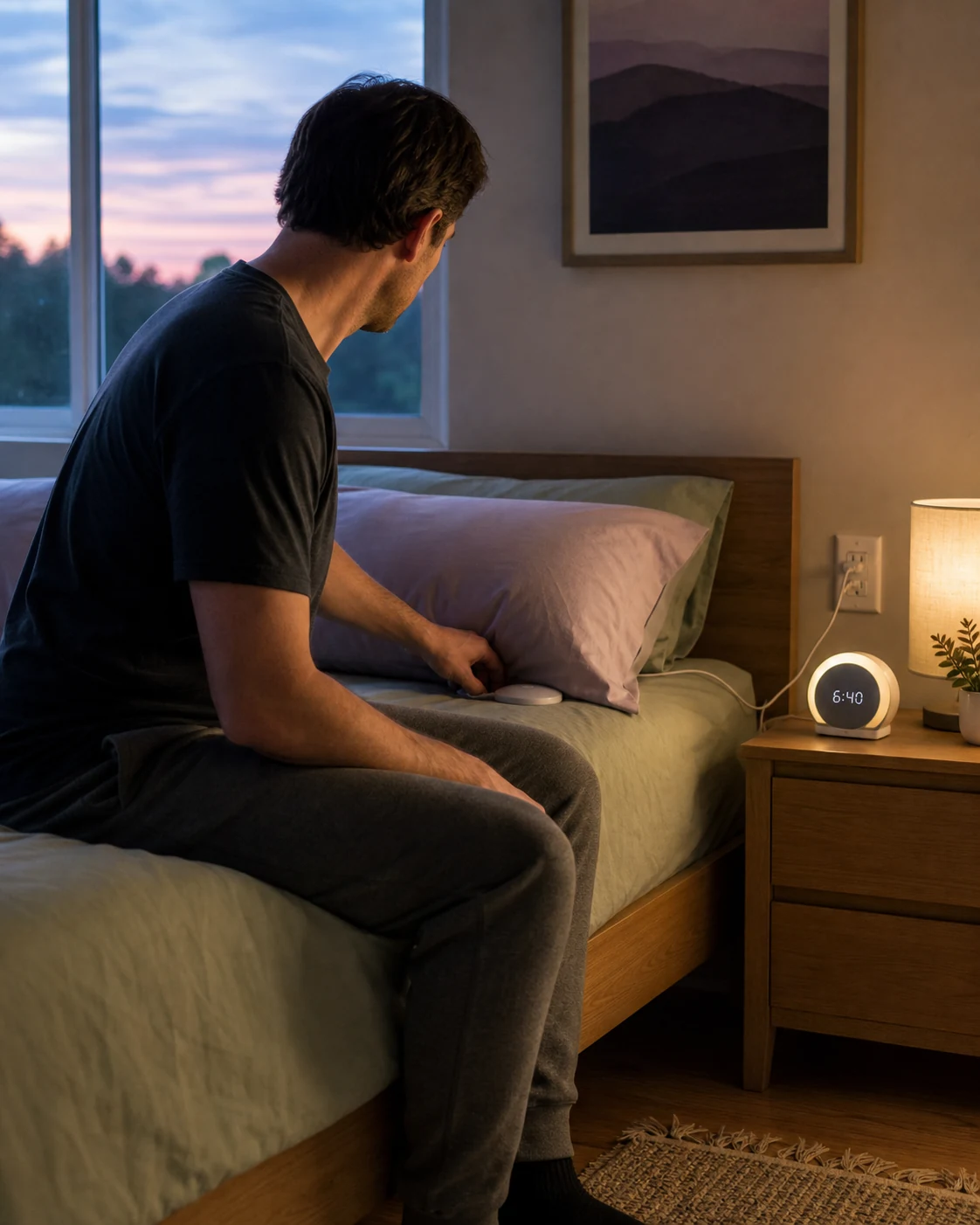
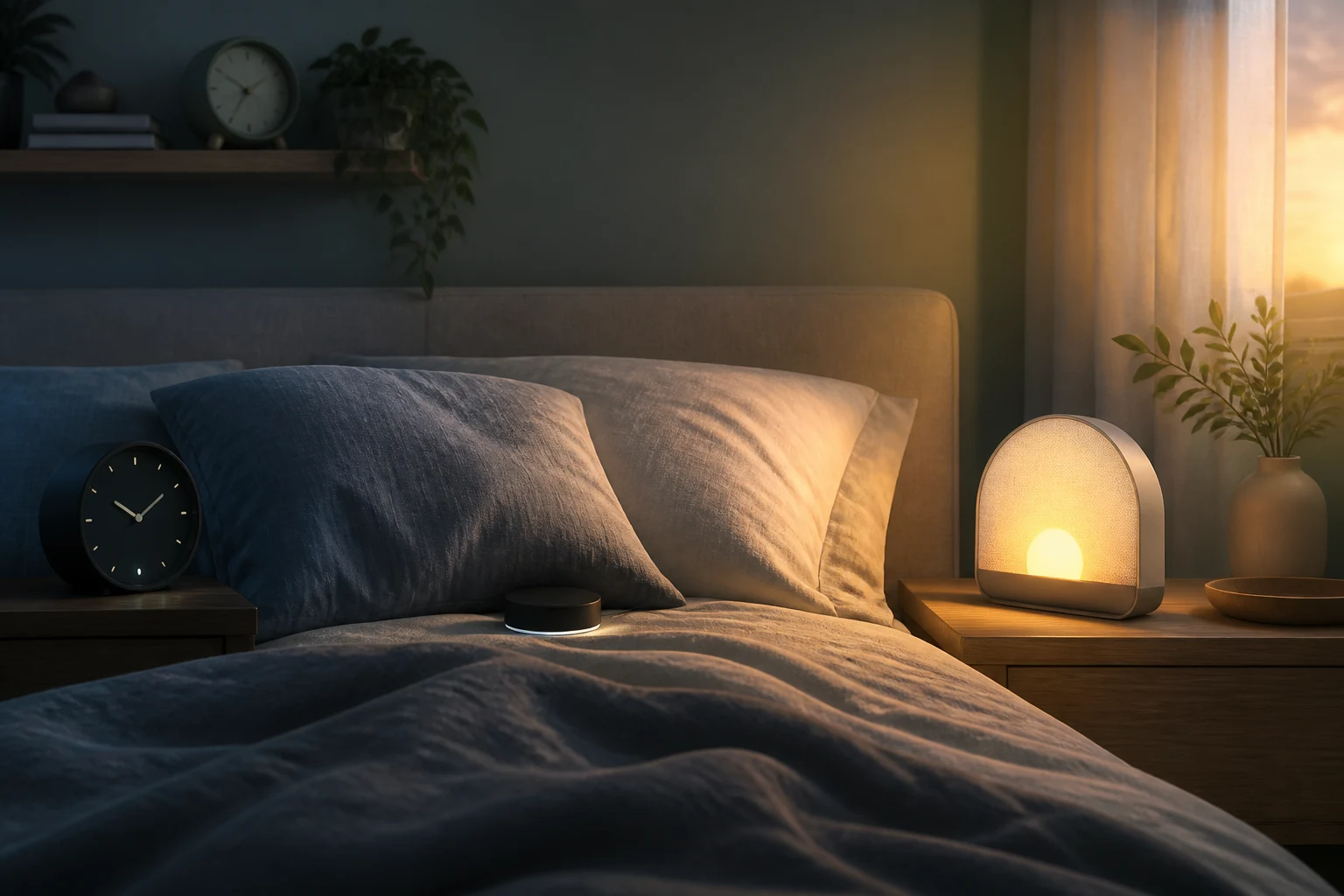
Person testing alarm placement, wake light, bed shaker, and power cable before an important morning
Test placement and signal delivery from the bed before the alarm becomes the only fallback.

Questions that change the route

Alarm Clock Questions to Resolve Before Comparing Models

Is there one best alarm clock for everyone?

No. A model can be excellent at producing sound and still be wrong for a sleeper who needs vibration, a partner who needs quiet, or a room where the display cannot be dimmed enough. Define the primary wake signal, the most important failure case, and one or two disqualifying constraints before reading rankings.

Should a heavy sleeper simply buy the loudest alarm?

Only when sound perception is the failed step. If the sleeper hears the alarm but dismisses it automatically, movement, control placement, or a second signal may be more relevant. If sound is often missed, compare adjustable audible alerts with vibration or light rather than assuming one maximum-volume setting fits every room.

Can a sunrise alarm replace sound?

It can for some sleepers, but the result depends on placement, room brightness, timing, and individual response. A first-night test should confirm that the light reaches the sleeping position. When punctual waking has a high consequence, choose a model that can add sound or keep a separate backup until light alone has proved dependable.

What is the difference between battery operated and battery backup?

A battery-operated clock uses batteries as its normal power source. A mains-powered clock with battery backup may behave differently during an outage: the battery might run the alarm, or it might only retain the time and settings. Check the manual and test the exact model instead of relying on the phrase “battery backup.”

When is a dedicated alarm clock better than a phone?

A dedicated clock can separate the wake-up job from notifications, bedtime scrolling, and phone charging. A phone may still be better when flexible schedules, wearable vibration, or app automation is the main requirement. Compare what must work locally, how the alarm is verified, and what happens after a restart or depleted battery.

Which route is appropriate when sound is not reliable?

Start with non-audible alarm routes: vibration, flashing light, or a combined alert. Verify the delivery hardware, placement, compatibility, and backup signal. Accessibility needs should be treated as the primary selection requirement, not as an extra feature added after choosing a conventional sound alarm.

Build your wake profile

Find the alarm that fits the room

Start with a category or sleeper profile. Heavy sleepers may need layered signals; deaf or hard-of-hearing users need an accessibility-first route. Parents, couples, and shift workers face different constraints.

TOPCLOCKS reviews alarm clocks by night controls, display brightness, partner impact, power resilience, and app or subscription friction.